Survivor demands in response to KCPAO’s offensive presentation about sex trafficking and Seattle Public Safety committee’s complicity

On Tuesday, January 27th, the King County Prosecuting Attorney’s Office (KCPAO) gave a presentation about sex trafficking at a meeting of the Public Safety committee of the Seattle City Council that featured unredacted, identifiable images of brutalized, bloodied, and tortured women, accompanied by graphic depictions of their rapes and assaults, including a list of foreign objects inserted into their bodies, and other dehumanizing language and comments about women who engage in the sex trade.

While the Public Safety committee chair councilmember Bob Kettle has apologized for allowing a public display of dehumanizing images of victims and survivors, we believe that it was part of a larger pattern of instrumentalization and exploitation of survivors, sex workers, and people in the sex trade by the KCPAO and Public Safety committee members in their effort to promote their preferred policy position of expanding the power and reach of the law enforcement.

While the KCPAO and Public Safety committee members selectively quote voices and stories of survivors that are convenient for their goal, those voices are far from consensus or even majority necessarily. Instead of honoring diverse perspectives of survivors, sex workers, and people in the sex trade, those of us who disagree with further criminalization are routinely dismissed as ignorant or privileged, explained away as speaking from trauma, or simply ignored and silenced.

It was evident throughout the conversations about prostitution loitering and SOAP ordinances back in 2024, when people with personal histories in the sex trade who opposed the proposed ordinance struggled to be heard at all, while an organization supporting the ordinance was repeatedly given time to present to the council, then subsequently received $1 million in a no bid direct contract from the City Council. That organization is now mired in allegations of serious human rights violations against women they are supposed to be helping.

Even during the Public Safety committee meeting in which the KCPAO gave the offensive presentation, prosecutors and Councilmembers made numerous comments denigrating and dismissing survivors, sex workers, and people in the sex trade who oppose further criminalization. For example, Councilmember Kettle questioned the psychological state of those who disagree with his policies, including survivors, sex workers, and people in the sex trade, repeatedly dismissed us as members of the “chattering class” who are ignorant about the reality of violence against women, and accused us of yelling at and targeting Councilmembers like himself.

Councilmember Rivera mischaracterized and dismissed survivors, sex workers, and people in the sex trade who disagree with her as members of the privileged few, and argued that policies the Council is discussing have nothing to do with us, even though we are speaking out against policies that directly harm us. She further chastised survivors, sex workers, and people in the sex trade who disagree with her for not listening to Councilmembers like herself, rather than the other way around.

When Councilmember Lin asked prosecutors about survivors who disagree with their approach, a prosecutor suggested that we are traumatized as children and are speaking from our trauma because that is all we have and know, instead of acknowledging that we are capable of forming our own opinions about what policies would help or harm our community based on our personal experiences and those of our peers, and that we have valuable insights that should be respected, whether or not they ultimately agree or disagree with us on any given policy. It was also telling that my public comment alerting the committee about the exploitative use of survivor stories and imagery “in complete disregard for survivor safety, privacy, or dignity” prior to the KCPAO presentation was entirely ignored as if nothing happened. This pattern goes beyond ordinary disagreements over policy preferences.

When the KCPAO and Public Safety committee members selectively promote survivor voices and stories that are advantageous for their policy positions while dismissing, mocking, and infantilizing voices and stories of other survivors, sex workers, and people in the sex trade, they are not listening to survivors: they are exploiting survivors, as they did when they publicly shared vulnerable survivors’ images and defended doing so by arguing that they are part of some obscure court filing, making them public records.

Therefore we demand:

  1. An acknowledgment of the pattern of selective and exploitative uses of survivor stories, voices, and images in policy advocacy by the KCPAO and Public Safety committee.
  2. An examination of City and County policies, guidelines, and trainings (or lack thereof) on ethical, trauma-informed, and non-exploitative uses of survivor voices and stories.
  3. A systemic and empirical analysis conducted by the Seattle Office of Civil Rights on existing and potential policy approaches to reducing violence and exploitation in the sex trade as well as a review of best practices for incorporating diverse voices of survivors, sex workers, and people in the sex trade while minimizing re-traumatization.
  4. The establishment of strategies to honor and include diverse perspectives of survivors, sex workers, and people in the sex trade in future policy conversations and to resource peer-led community-based organizations that provide outreach, support, and services without requiring that they collaborate or cooperate with the law enforcement.
  5. A Public Safety committee meeting dedicated to a presentation about human rights-based, non-carceral, pro-sex worker approach to empower survivors, sex workers, and people in the sex trade and combat violence, abuse, and exploitation within the sex trade.

We present this list of demands to the Seattle City Council, King County Council, Seattle City Attorney’s Office, King County Prosecuting Attorney’s Office, Seattle Mayor’s Office on Domestic and Sexual Violence, Seattle Office of Civil Rights, and King County Office of Equity and Racial and Social Justice, and invite each entity to conduct inquiry as deemed appropriate and to work with us to remedy damages done to survivors, sex workers, and people in the sex trade, and to prevent future harms.


We Participate in King County’s 2026 Human Trafficking Prevention Month Proclamation

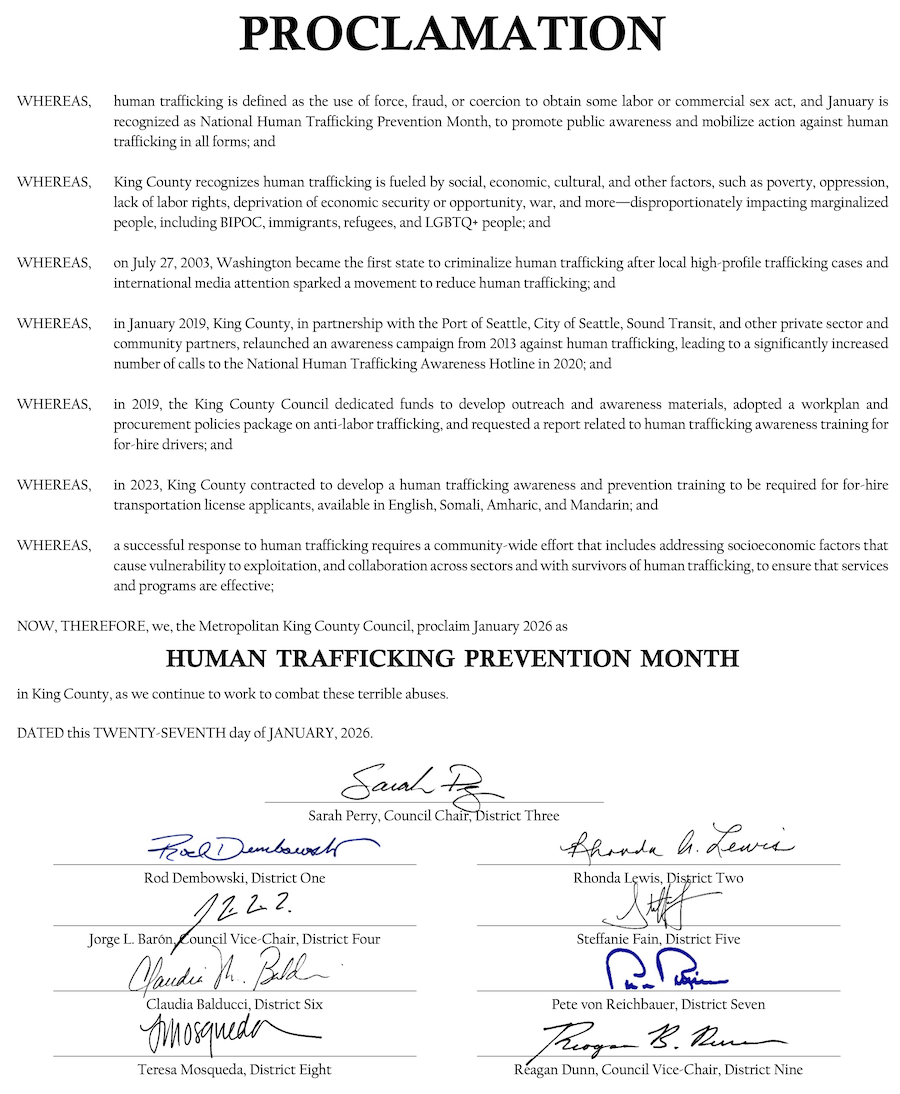
On January 27th, Emi from Coalition for Rights & Safety was invited by King County Counil to formally receive this year’s Human Trafficking Prevention Month proclamation at the Council’s regular meeting. We had worked with Councimember Teresa Mosqueda’s office to insert a line about the need to address socioeconomic conditions that produce vulnerabilities to abuse and exploitation into this year’s proclamation. Councilmember Mosqueda was joined by Councilmembers Lewis and Dunn as sponsors of the proclamation.

Click on the image to view the actual proclamation.

2026 Human Trafficking Prevention Month Proclamation

Below is the text of a brief remarks Emi gave at the proclamation ceremony.

#####

Thank you, Councilmember Mosqueda and the entire King County Council, as well as County employees who work in public health, human service, and adjacent departments, for your continued leadership in addressing human trafficking in our region, and for the opportunity for me to speak to you today.

My name is Emi Koyama and I am a survivor and longtime advocate. I am the director of Coalition for Rights & Safety for People in the Sex Trade and a co-founder/co-director of Aileen’s, a peer-led community hospitality space, street outreach, and leadership development program by and for women working along the Pacific Highway in south King County, mostly operating in Federal Way and Kent/Des Moines area, Districts 5 and 7.

I am particularly pleased to see that this year’s proclamation calls attention to socioeconomic conditions that produce vulnerabilities to exploitation and abuse. We all know by now that Black and Indigenous children, youth and adult women, queer and trans folks, immigrants, and members of other marginalized communities are at vastly heightened risk of being exploited and abused, but we have not done enough to explore why this is so and how to remedy these underlying conditions, other than simply naming racism or transphobia. But nobody is born vulnerable: we are made vulnerable due to the organized abandonment and the failure of public policies.

We often talk about holding those accountable for the exploitation and abuse of another person, but we don’t hold ourselves accountable for the failures of our public policies to provide adequate food, housing, healthcare, jobs, education, childcare and eldercare, and equitable access to opportunities and dreams worth striving toward. We talk about how Black and Indigenous women are particularly vulnerable to trafficking and yet fail to seriously consider reparations for centuries of publicly sanctioned dispossession of and control over Black bodies from the Slavery to Black code and convict leasing to mass incarceration, or the actual, material restoration of indigenous land, resources, and sovereignty that indigenous nations need to protect their own communities.

We at Aileen’s reach about a hundred women each year who regularly or on occasions engage in or have engaged in the sex trade. We know exactly what they want and need in order to protect themselves and their children, improve their lives, and go from simply surviving to thriving, but the resources are not there. No amount of policing and prosecution after the fact stops trafficking when we continue to ignore socioeconomic conditions that produce and unevenly distribute vulnerabilities in a predictable pattern.

So on this day of the King County proclamation of the Human Trafficking Prevention Month, I hope that its call to address underlying socioeconomic conditions to exploitation and abuse would lead to an honest self-reflection as to how our public policies have failed and made vulnerable members of specific communities, and a real realignment of where we expend enormous resources and powers of the local government.

Thank you very much.

Massage Parlor Outreach Project Links

Massage Parlor Outreach Project/CID Coalition Statement:
Solidarity with Massage Parlor Workers Means Ending Police Raids and Patrols in the CID

Massage Parlor Outreach Project collaborative members:

Massage Parlor Outreach Project on Social Media:

Facebook: https://www.facebook.com/110436964153952/
Instagram: https://www.instagram.com/mpop_sea/

Vigil photos by Mel Ponder Photography:
https://www.facebook.com/media/set/?set=a.123130783156661&type=3

Vigil promo images for social media:
https://1drv.ms/u/s!Asp-Sx_gj6JNiXYBnEpaF7DUwwKy?e=ByKxdM

Recent articles mentioning MPOP:

Not another bs PR statement about #BlackLivesMatter

It’s been a rough week of sadness and outrage. I am forced to be in quarantine to avoid coronavirus because I have many compromising medical conditions but every day I’ve been following many of my friends fight for systemic changes we seek, whether they are on the street or online. I feel heavy yet hopeful that this time, the national uprising will lead to lasting movement toward a more just society. When the coronavirus is sufficiently contained or vaccine becomes available, I anticipate that the struggle for racial justice and liberation of Black and other marginalized people will still be ongoing, and I look forward to joining you out there.

On behalf of the Coalition for Rights & Safety for People in the Sex Trade, I signed on to the call to Defund the Seattle Police Department, which demands the City of Seattle to: 1. defund Seattle Police Department (at least 50% of $363 already budgeted for SPD); 2. fund community-based health and safety initiatives that diminish reliance on the police to solve social problems; and 3. drop charges against protesters. You can join the call as an individual or as an organization by clicking on the link below:

http://tinyurl.com/defundSPD (individual)
http://tinyurl.com/defundspdorg (organization)

As the subject of this post says, I am getting fed up with bunch of self-serving PR statements arriving on my inbox from corporations and organizations expressing support for Black lives that do not reflect their day-to-day operations. Today, I received an email from a local (predominantly white, police-friendly) “anti-trafficking” coalition soliciting donations to themselves, claiming that their mission aligns with the goals of Black Lives Matter, after years of promoting more policing and prosecution of those involved in sex trade which further criminalize Black, indigenous, and people of color. They even quote a white academic “expert” who equates prostitution to slavery, comparing their white supremacist carceral politics to actual abolitionists who fought against American chattel slavery and continue to fight against the unjust criminal justice system and the Prison Industrial Complex. And of course they had to stress that they only supported “peaceful” protest by doubly emphasizing the word “peaceful” by italicizing and then underlining the word. This is opportunistic and shameful. You cannot promote carceral approach to social problems and then claim to be in the movement for Black lives at the same time.

I hesitated making a formal statement on behalf of the Coalition for Rights & Safety about recent police murders of George Floyd, Breonna Taylor, Ahmaud Arbery, Tony McDade, and many other Black men and women that we have not even heard about because so many of those statements are fake and I wanted to focus on mourning and fighting and supporting my friends rather than taking part in the PR fray. But when I saw anti-trafficking organizations using the national attention to their own advantage, I had to say something. But this is not just a statement; we commit to continue prioritizing the rights and safety for the most marginalized sex workers and people in the sex trade, especially sex workers who are Black, indigenous, or people of color, sex workers who are trans, are immigrants, are disabled, and/or lack housing.

Thank you for being in the movement with us. Please call me if you want to talk more about how we can continue to (and better) advocate for Black lives and the lives of other marginalized communities.

Emi Koyama
The Coordinatrix
Coalition for Rights & Safety for People in the Sex Trade

Also read:

You Can’t Say Black Lives Matter Without Including Black Sex Workers by Suprihmbé
Stop Calling Human Trafficking “Modern Day Slavery”

Support Aileen’s, our new community organizing and hospitality space for women working along the Pac Hwy

Aileen’s is a new peer-centered organizing and hospitality space for women working along the Pac Hwy. This is the area south of Seattle stretching from around SEATAC airport to the south end of King County that is home to many women who trade sex and where Gary Ridgeway, a.k.a. Green River Killer, sought his victims.

We are fed up with the lack of services and resources for empowerment in south King County. Pressing concerns include homelessness, legal issues, CPS involvement, substance use problems, domestic violence, police harassment and brutality, sexual assault and harassment, racism, transphobia, among others.

Women along the Pac Hwy need a safe place to get off the street, even for temporarily, a place to get and give support without being hated or judged, a place to share safety information like the bad date line and receive life saving harm reduction tools.

We are currently forming a steering committee of peers to guide Aileen’s as we envision and create our space. Initial plans include a kitchenette with hot drinks and snacks, a dressing room and clothes closet, lounge area, computer and phone access, and an office space offering peer counseling, harm reduction and overdose prevention services, and community resources and referrals.

Aileen’s is by and for women in the sex trade, women who are homeless or unstably housed, women doing survival sex, coming out of prison, having their kids taken by CPS, struggling to make ends meet, as well as women with former lived experience, and sex workers from all walks of life. We welcome volunteers/allies willing to complete our training.

Please support the work of Aileen’s by making a generous donation online at www.gofundme.com/aileens or to: Church of Harm Reduction, PO Box 3484, Federal Way, WA 98063. Aileen’s is a joint project of community groups including Church of Harm Reduction and Coalition for Rights & Safety for People in the Sex Trade.

Also: Join Aileen’s Open House on May 7th at 6-9pm. Please visit www.aileens.org or email info@aileens.org for location.

Report Issued for the Coalition's First Six Months

Coalition for Rights & Safety for People in the Sex Trade issued a semiannual report on its activities since the founding in March 2017. In this six months, the Coalition grew from a figment of imagination into a network of 14 community groups concerned about the safety and rights of people in the sex trade and began working on a variety of policy change projects. Click here to read the report!