On January 27th, Emi from Coalition for Rights & Safety was invited by King County Counil to formally receive this year’s Human Trafficking Prevention Month proclamation at the Council’s regular meeting. We had worked with Councimember Teresa Mosqueda’s office to insert a line about the need to address socioeconomic conditions that produce vulnerabilities to abuse and exploitation into this year’s proclamation. Councilmember Mosqueda was joined by Councilmembers Lewis and Dunn as sponsors of the proclamation.
Click on the image to view the actual proclamation.
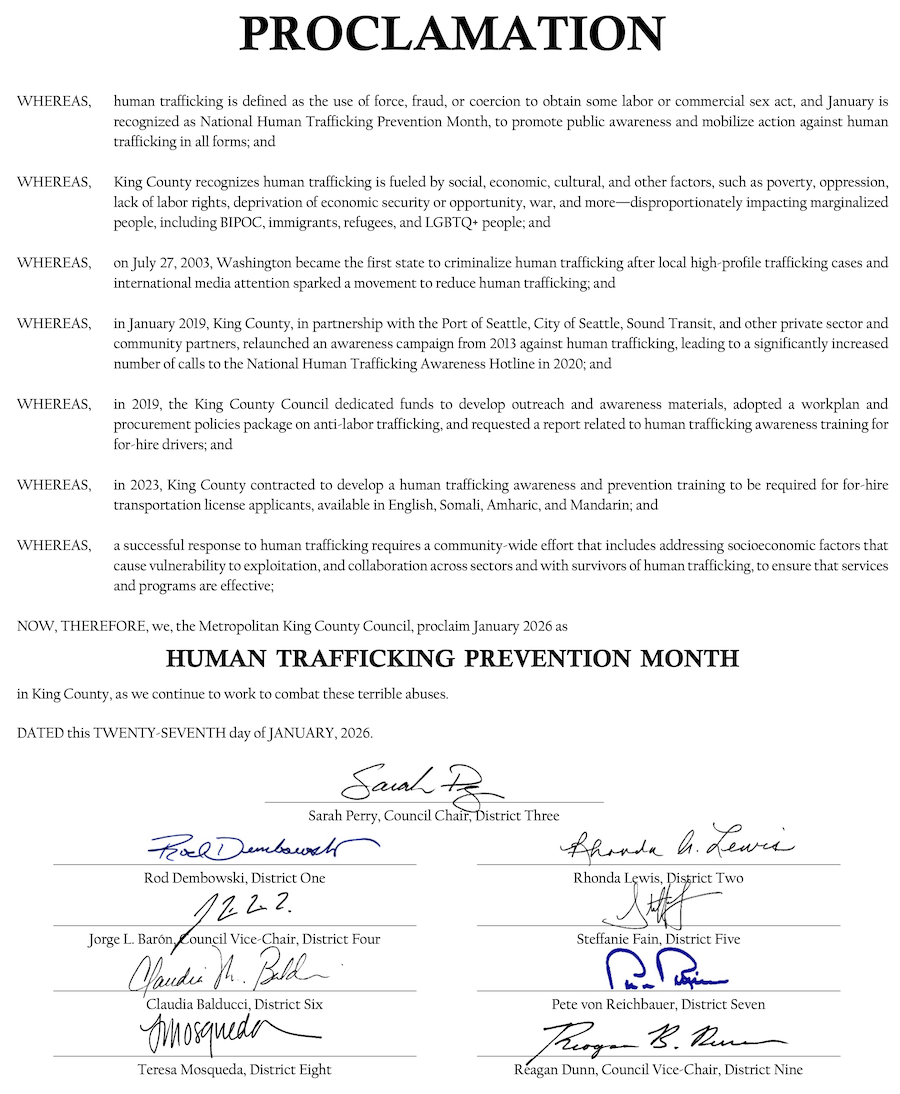
Below is the text of a brief remarks Emi gave at the proclamation ceremony.
#####
Thank you, Councilmember Mosqueda and the entire King County Council, as well as County employees who work in public health, human service, and adjacent departments, for your continued leadership in addressing human trafficking in our region, and for the opportunity for me to speak to you today.
My name is Emi Koyama and I am a survivor and longtime advocate. I am the director of Coalition for Rights & Safety for People in the Sex Trade and a co-founder/co-director of Aileen’s, a peer-led community hospitality space, street outreach, and leadership development program by and for women working along the Pacific Highway in south King County, mostly operating in Federal Way and Kent/Des Moines area, Districts 5 and 7.
I am particularly pleased to see that this year’s proclamation calls attention to socioeconomic conditions that produce vulnerabilities to exploitation and abuse. We all know by now that Black and Indigenous children, youth and adult women, queer and trans folks, immigrants, and members of other marginalized communities are at vastly heightened risk of being exploited and abused, but we have not done enough to explore why this is so and how to remedy these underlying conditions, other than simply naming racism or transphobia. But nobody is born vulnerable: we are made vulnerable due to the organized abandonment and the failure of public policies.
We often talk about holding those accountable for the exploitation and abuse of another person, but we don’t hold ourselves accountable for the failures of our public policies to provide adequate food, housing, healthcare, jobs, education, childcare and eldercare, and equitable access to opportunities and dreams worth striving toward. We talk about how Black and Indigenous women are particularly vulnerable to trafficking and yet fail to seriously consider reparations for centuries of publicly sanctioned dispossession of and control over Black bodies from the Slavery to Black code and convict leasing to mass incarceration, or the actual, material restoration of indigenous land, resources, and sovereignty that indigenous nations need to protect their own communities.
We at Aileen’s reach about a hundred women each year who regularly or on occasions engage in or have engaged in the sex trade. We know exactly what they want and need in order to protect themselves and their children, improve their lives, and go from simply surviving to thriving, but the resources are not there. No amount of policing and prosecution after the fact stops trafficking when we continue to ignore socioeconomic conditions that produce and unevenly distribute vulnerabilities in a predictable pattern.
So on this day of the King County proclamation of the Human Trafficking Prevention Month, I hope that its call to address underlying socioeconomic conditions to exploitation and abuse would lead to an honest self-reflection as to how our public policies have failed and made vulnerable members of specific communities, and a real realignment of where we expend enormous resources and powers of the local government.
Thank you very much.